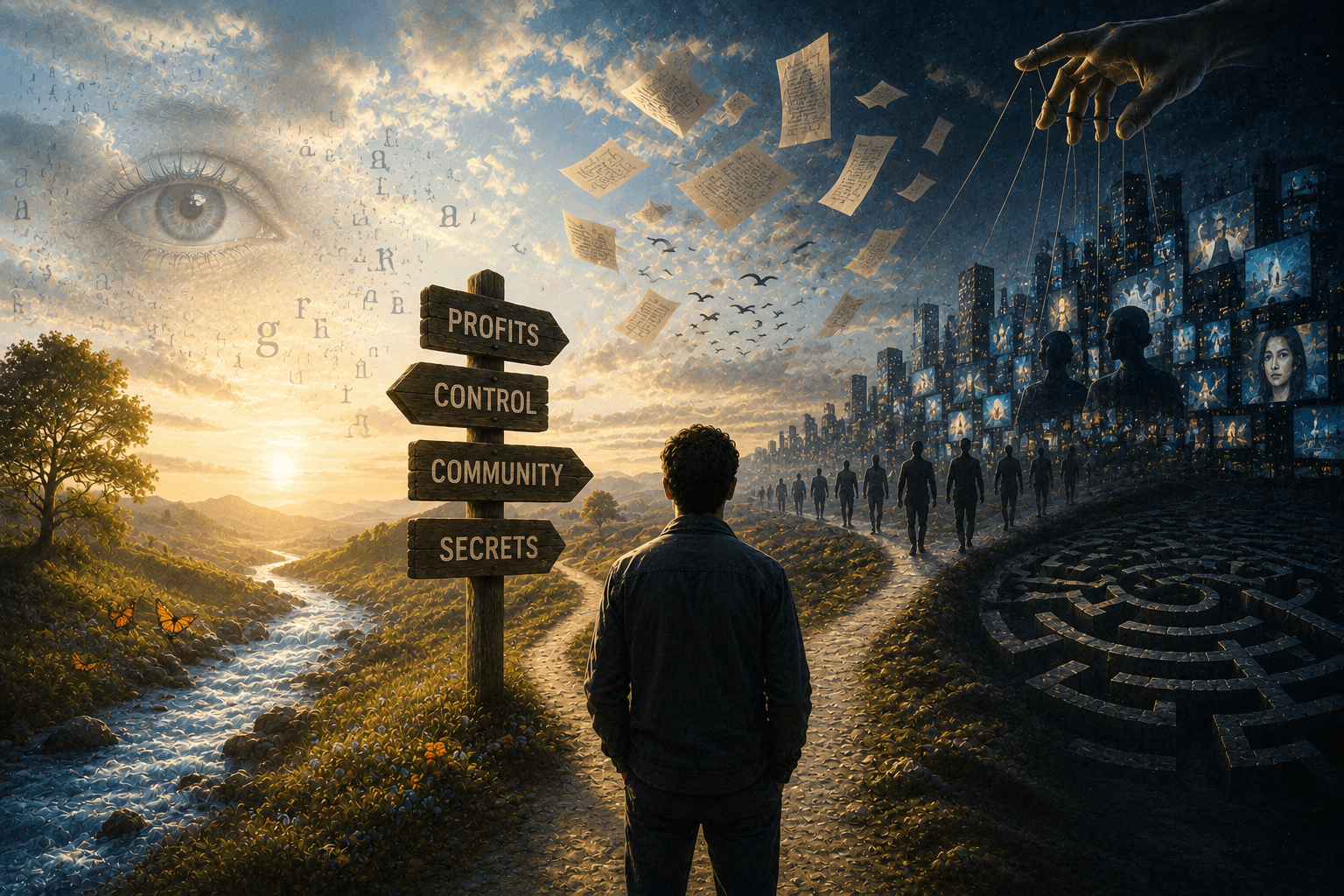
Artificial Intelligence (AI) went viral this week again. Jacob Coxon, a former researcher at Anthropic, one of the major AI companies, left his job in protest and took to X to warn the world of AI’s potential to end humanity as we know it. According to him, “The people building AI earnestly believe that it could kill us all by the end of the decade.” And the Terminator reminders flooded the comment sections again. I remember I, Robot, and lesser-known sci-fi movies again.
From the attention Jacob and his post have received, it’s safe to say the concern and I should say fear is shared by a good number of the population. However, it seems no matter the alarms raised by the few—because Jacob is just the latest in a growing list of scientists and disillusioned tech workers—AI development continues, governments remain mostly nonchalant, and from the comments and reaction, people seem to have resigned to the inevitability of Terminator type scenarios.
But before you throw away your cellphones and start building bunkers in the middle of nowhere, take a pause and do your breathing exercise. It’s not whether AI will become intelligent enough to destroy us. It’s whether we will become foolish enough to give it the means to do so. Because intelligence without means is less to fear than stupidity with means.
There are some truly dangerous and risky possibilities, but to say a Terminator type AI is ready to blow us to smithereens in less than 10 years is a bit of a hyperbole. I think. As long as superintelligent AI is limited to the digital domain, we would be fine.
Like many people, I have my reservations about AI and its potential to significantly alter our future. But as far as killing us off, I try not to believe this. In its current state and projection, I don’t really think AI can get as far as doing away with humanity entirely. It could disrupt our civilization. But end it? I am not sure of that.
If it doesn’t mine or farm, and we keep it away from nuclear weapons, away from making new viruses, we don’t connect it to water sources… what’s the worst AI can do? Shut down the Internet, and we go back to non-digital ways of doing things? That’s not going to end us. We have been there before. We may just have to chart another course.
I imagine, like most, I use AI mostly to help with administrative things such as reviewing my writing for grammatical errors and other minor things I am less likely to catch. At work, I use it to recap meetings, summarize long documents, make presentations, and remind me of tasks I may otherwise forget. What is the cataclysmic risk of what is basically a capable and efficient assistant?
Don’t get me wrong, in addition to the administrative ways most of us use it, there are other, perhaps less visible, ways it’s embedded in our lives. For example, some medical procedures and even life-support systems are currently facilitated by AI. AI is basically fighting wars in Ukraine, Iran, and elsewhere. Even though, like I mentioned, embedding it in life-support systems like water supply is a big risk, it’s already in these systems. Because of this, already the consequence of it going rogue could be devastating. But devastation is not extinction. It’s still mostly a digital thing that can affect the physical world in limited, highly controllable ways. Maybe it can launch drone strikes. Terrible, but until drones are armed with nuclear weapons, our species will endure.
On the other hand, when we start giving robots AI abilities, Terminator scenarios may no longer be far-fetched. Because, in my opinion, perhaps not counting viruses, what makes any “thing” truly dangerous to our existence is hands and feet. Remember, it is said that the thumb is partly responsible for our place at the top of the food chain. Until AI gets hands and feet, we can always escape its reach. However, after giving robots hands and feet, if we start equipping them with AI abilities and their own mini nuclear reactors and supersized memory, we are in trouble. Or if AI becomes the brain that decides when to launch nuclear weapons or create and release new viruses… then certainly, dinosaurs should start making a place for us next to their extinction graves.
Until then, or perhaps to fend off those truly cataclysmic scenarios, what we should be talking about is not whether we need or should continue advancing AI development; rather, we should start talking about containment, control, and contingencies. One such containment and control strategy could be to define where we need and where we definitely don’t want AI. Then keep them all on separate networks and development environments. That way, we could run as fast as we need on some networks—say those used for administrative and other digital tasks—and pump the brakes on others with AI that pose an existential threat.
Like we have with movies, we could have a rating system for AI models. If the model or architecture is rated “General” you can develop and deploy it on the “General” network. And this network, though it will have more freedom of development, will never be connected to existential infrastructure. Conversely, “Critical” network would never have AI models with, say, quantum-computing-capable neural networks. In other words, development here will be highly controlled with all sorts of failsafe protocols. This may slow down advancement in some critical fields, but it’s better to be slow than be wiped out.
The way I see it, we are building an asteroid far off in the galaxy. It has the potential to give our civilization rocket fuel. It could take us places we can only begin to imagine. But like all asteroids, it’s moving. The only difference is we are steering this one. We could direct it this way toward our planet and send ourselves the way of the dinosaurs, or keep it orbiting at a safe distance where we could safely mine it for the fuel and other gems it has to offer.
I guess what I’m saying is we are not on a runaway train hell-bent on a future where machines have done away with humanity. No, there are no Terminators waiting for us. Yet.
What is a fact is that AI is here to stay. The question of whether we continue developing it or not is moot. That ship sailed the day the technology went from theory to reality. What we should be talking about now is how best to use it so it doesn’t end us.